
Most people who come to me about Dubai Hills know roughly what they want to spend. What they do not know is what actually happens between agreeing a price and having the title deed in their hand. It is a regulated process, and once you have done it once it is predictable enough. First time round it feels like a relay race where nobody has told you who is holding the baton.
I sell resale villas in Dubai Hills, so this is the route I take buyers down most weeks. The rules come from the Dubai Land Department. Fees change, so check the official DLD page before you rely on any number here.
Why a Dubai Hills villa is almost always a resale
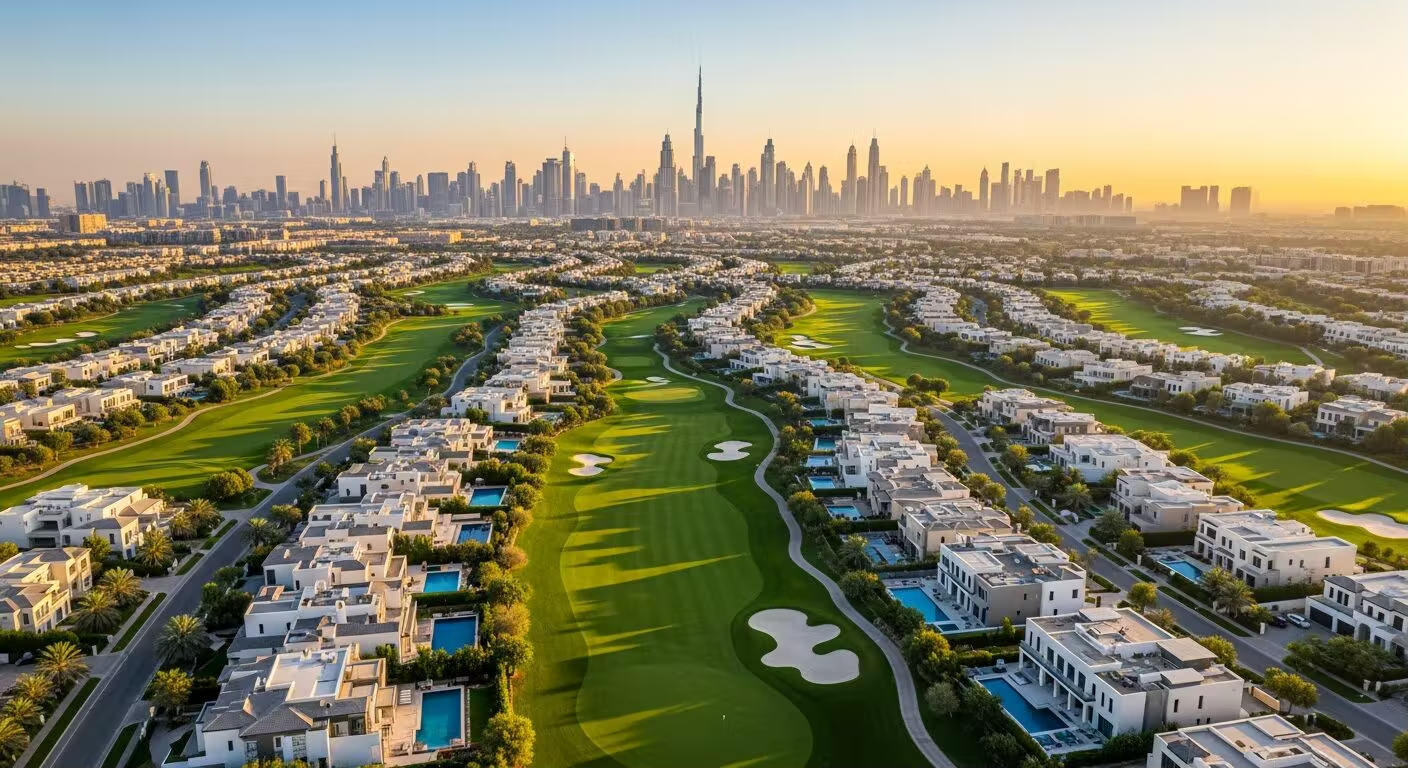
Dubai Hills Estate is Emaar's master community on Al Khail Road, built around an 18-hole championship golf course. Emaar puts it at over 11 million square metres. The villa and townhouse side is pretty much built out now. Emaar is still launching apartments in the wider estate, but if you want a villa you are buying from an existing owner. Property Monitor's numbers for the year to 4 November 2026 say the same thing: 240 registered villa transactions in Dubai Hills Estate, 219 of them resales. Those counts include gifts and other registrations, not just sales, but you get the picture.
Why that matters: off-plan, you sign with the developer and pay on a schedule. A resale has a seller, possibly the seller's bank, a no-objection certificate from Emaar and a transfer at a trustee office. Each one has its own paperwork and its own timing, and that is where people get caught out.
Step 1: pick the community and the position first
There are fourteen villa and townhouse communities in the estate. Maple is townhouses. Sidra is detached family villas. Parkways, Fairway Vistas and the Hills View and Hills Grove mansions are the top end. Which one is right comes down to bedrooms, budget and how you actually live.
Within a community, position moves the price as much as the house does. Same floor plan, but one backs onto the park, the greenbelt or the golf course and the other backs onto a road. Different proposition altogether. Condition is the same story. A properly renovated villa and one in original condition can sit on the same street and be a long way apart on price.
If you want a feel for where the market is, Property Monitor has the median Dubai Hills villa at AED 6,367,002 over the twelve months to 4 November 2026. Starting point only. A median across fourteen communities tells you very little about one villa, which is why you want registered sales of the same type in the same sort of position.
One thing I tell everyone: drive the school run at the time you would actually be doing it. There are several international schools inside and around the estate, GEMS Wellington Academy among them. The KHDA directory has the current list, the curricula and the latest inspection ratings, and that is the version worth checking rather than anything I print here. Close on a map can still be a slow loop at 7.30am.
Step 2: sort the money before you offer
Paying cash? Have proof of funds ready, because sellers and their agents will ask for it.
Need a mortgage? Get a pre-approval from a UAE bank before you start negotiating. Banks licensed by the Central Bank of the UAE can lend on Dubai property. How much they will lend as a share of the price depends on residency, the property's value and whether it is your first home in the UAE, so ask the bank for its current limits rather than working from a figure you read somewhere.
Pre-approval is not the end of it. Once you have agreed a price the bank sends its own valuer round. If the valuation comes in under the agreed price, the bank lends on the lower number and you find the difference. I have seen this catch people on renovated villas, where the work has not yet shown up in registered sale prices.
Step 3: the offer and the MOU, Form F
Price agreed, you sign a memorandum of understanding. In Dubai that is the standard sale contract, Form F. The DLD's investor guide says the parties have to use the standard form, and they can attach their own terms as long as those do not conflict with it.
What I make sure goes into the MOU: the price, and who pays the DLD registration fee. The deposit, who holds it and when it is released. The target transfer date. Conditions, like mortgage approval and vacant possession. And what stays in the villa, white goods through to the outdoor kitchen.
If there is an agent involved, the DLD's standard broker appointment form gets signed too. Check your agent is registered with RERA. The DLD itself tells you not to use unregistered brokers.
Step 4: look at the villa properly
The DLD guide says to inspect a completed property before you sign the sale contract. I would go further. Do it properly, ideally with a surveyor or a snagging company.
I developed houses in the UK before Dubai, so I look at a villa as a building first. The things I check for in Dubai Hills are extensions, enclosed terraces and pergolas. Ask whether the alterations had the approvals they needed, and ask to see the paperwork. Emaar's community management is where to confirm what was required. If the seller cannot produce it, that goes into the price or the conditions.
And check the seller actually owns the villa and what is secured against it. The DLD guide suggests confirming the property is free of mortgages and other liens.
Step 5: the developer NOC
In a freehold community like Dubai Hills, the DLD will not transfer the property without a no-objection certificate from the developer. The DLD's sale registration page lists it as an e-NOC from the developer, issued through the Dubai REST app. It confirms the seller has paid the service charges and nothing else is standing in the way.
The seller applies for it and the developer charges an admin fee. Ask for it early. Unpaid service charges are one of the most common reasons a transfer date slips.
Step 6: if the seller has a mortgage
Plenty of the villas I sell are still mortgaged when they come to market. The seller gets a liability letter from their bank showing what is outstanding, and that has to be cleared before the title can pass to you.
Cash buyer: you usually pay the seller's bank directly and the bank releases the mortgage. Mortgaged buyer: the two banks have to coordinate, and that takes longer. This is the stage with the most moving parts, so give it time.
Step 7: transfer day at the trustee office
The DLD registers sales through licensed Real Estate Registration Trustee offices. Both sides turn up, in person or through someone with a notarised power of attorney. Bring Emirates ID, or a valid passport if you are non-resident, plus the e-NOC and the payments due that day.
The trustee checks the documents, enters the transaction and takes the fees. Once the DLD approves it, the title deed comes out in your name. The DLD's investor guide says it can all be done the same day if everything is in order. The days I have seen go wrong are the ones where a cheque was made out to the wrong party or someone forgot a document.
What it costs on top of the price
Government fees, as the DLD publishes them:
| Cost | Amount | Where it comes from |
|---|---|---|
| DLD sale registration fee | 4% of the price. The DLD lists 2% seller and 2% buyer; its investor guide says equal parts unless agreed otherwise | DLD, sale registration |
| Trustee office fee | AED 4,000 plus VAT where the price is AED 500,000 or more | DLD, sale registration |
| Title deed and other small DLD charges | AED 250 for the title deed, plus map and knowledge fees, listed individually | DLD, sale registration |
| Mortgage registration, if you borrow | 0.25% of the loan amount | DLD, Know Your Rights |
| Developer NOC | Set by Emaar. Ask for the current figure when the seller applies | Emaar community management |
| Agency commission | Agreed in the broker appointment form | Your broker form |
Who pays the 4% is set in the MOU. In practice the buyer often ends up paying all of it, so get it written down clearly. My own side of it is set out on the fees page.
After the transfer
Utilities go into your name and you will need access set up with community management. The utility transfer is done through DEWA, and they publish the current move-in steps and deposit. If the purchase is going towards a Golden Visa application, that is a separate process once ownership is registered.
The mistakes I see most
Agreeing a price before you know whether the bank's valuation will back it. Viewing once, at midday, and never seeing the street in the evening or at school-run time. Leaving the NOC to the week of transfer. And assuming an extension or enclosed terrace was approved because it looks well built.
None of it is hard on its own. Delays come from doing the steps in the wrong order, or one side finding out about a requirement too late. Know the sequence before you make an offer and you will negotiate better. You will sleep better too.